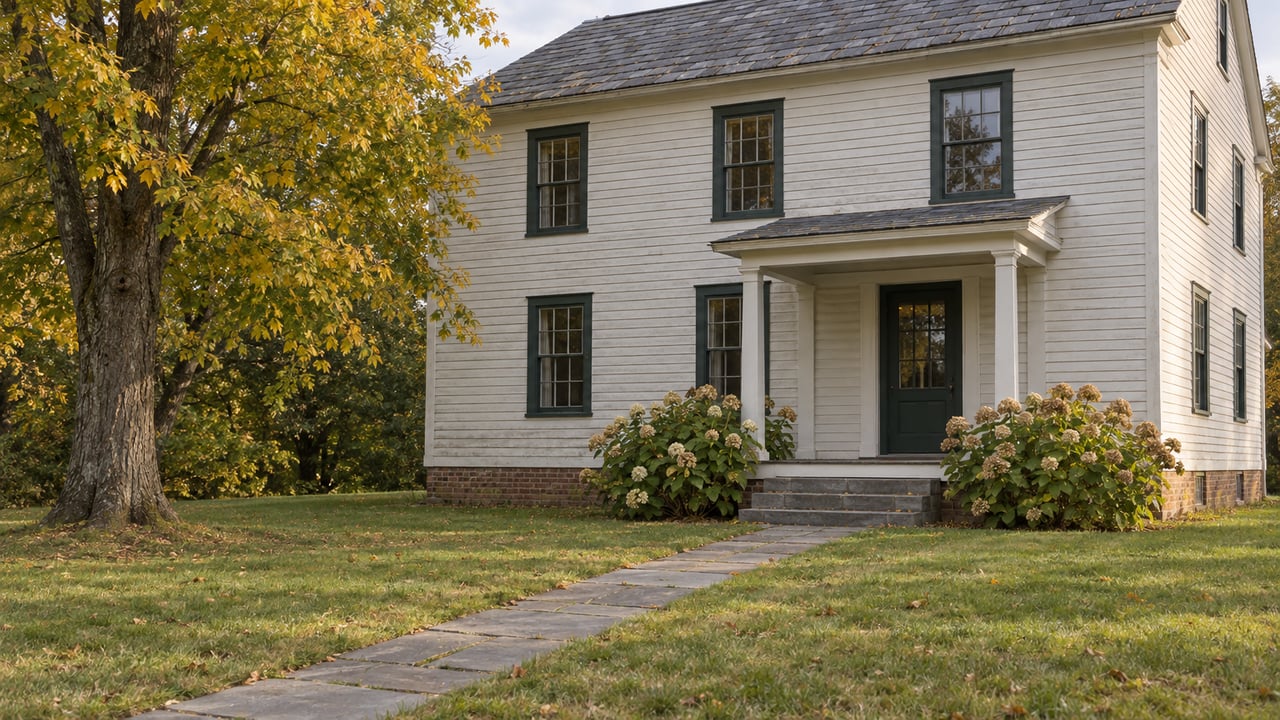
Two houses in New Windsor, both with a New Windsor mailing address, can sell for prices that differ by $159,000. Not because one has a pool and the other doesn't. Not because one sits on a busier road. The difference comes down to a line most buyers never think to check: which school district the parcel actually falls into. In New Windsor, roughly six in ten addresses land in the Newburgh school district, where the typical house sold for $433,200 in 2026 sales through mid-August. Nearly a third of New Windsor addresses are actually in the Cornwall district, where that same style of house sold for $592,500. Same town name on the envelope. Same zip code, in many cases. Two different markets.
This is the part that gets lost when someone compares Orange County towns using a portal's median price. The town isn't the pricing unit. The school district is, and in this county, district lines cut across towns constantly.
Why a Mailing Address Doesn't Settle the Question
Orange County's town boundaries and its school district boundaries were drawn at different times, for different reasons, and they don't line up cleanly. A house can carry a Middletown mailing address and sit inside the Minisink Valley or Pine Bush school district. A house in Monroe might be zoned for Washingtonville schools instead of Monroe-Woodbury. Chester splits three ways, across the Chester, Monroe-Woodbury, and Warwick districts. None of this shows up if you're comparing towns by their listing photos or their names.
The only way to know for certain which district a specific parcel belongs to is the property tax bill, not the mailing address on the listing. That single distinction changes how a buyer should read every "town comparison" chart online, because those charts are usually built on mailing addresses, which blend multiple districts into one number.
Here's what that blending hides, using 2026 sales data through mid-August for a handful of Orange County towns:
| Town | School district | Share of addresses | Typical sale price |
|---|---|---|---|
| New Windsor | Newburgh | ~60% | $433,200 |
| New Windsor | Cornwall | ~30% | $592,500 |
| Middletown | Middletown | ~60% | $416,000 |
| Middletown | Minisink Valley | most of remainder | $527,500 |
| Monroe | Monroe-Woodbury | ~67% | $567,500 |
| Goshen | Goshen | most | $543,950 |
| Warwick | Warwick Valley | nearly all | $587,500 |
| Newburgh | Newburgh | ~90% | $433,200 |
Look at Middletown and New Windsor closely. Both towns contain a cheaper majority district and a pricier minority district, and the gap in both cases is large enough to change a down payment calculation. A buyer who searches "homes in Middletown" and anchors on the $416,000 figure for the dominant district could be looking at a Minisink Valley-zoned listing at $527,500 without realizing why the number moved.
The Districts Aren't Aging at the Same Speed
The other place this catches people off guard is appreciation. If you last checked Orange County prices even two years ago, some districts will feel about right and others will feel wrong in a way that's hard to explain, until you separate them out.
Newburgh, Middletown, Minisink Valley, and Port Jervis are each up more than 20 percent since 2023. Goshen is up 14 percent over the same stretch. Warwick Valley, the most expensive district in the county, is also the flattest, up only about 1 percent in three years. That means an old mental price for a Warwick house is probably still close to right, while an old mental price for a Newburgh or Middletown house is likely to be badly out of date.
County-wide, the typical single-family home sold for $465,000 in 2025 and $487,500 in the January through mid-August window of 2026, an increase of about 5 percent in a year built on more than 1,300 sales. Compared like for like, matching similar houses on size, lot, age, and district, that same house is running closer to 19 percent higher than it was. The county figure smooths over the fact that some districts, like Warwick, barely moved, while others did most of the work, and it's the reason a single "Orange County median" is close to useless for judging any one address.
What the Contract Activity Is Already Showing
There's a second signal worth watching alongside price, and it points in the same direction. Looking at what's currently under contract by district rather than by town, Newburgh stands out as the busiest, with close to half of everything on the market there already tied up in a pending sale. Port Jervis sits at the other end, with roughly a quarter of its listings under contract, even though Port Jervis gained the most of any district over the past year. That combination, prices running up while contract activity slows, usually means asking prices got ahead of what buyers in that district are willing to pay right now. It's a pattern worth noticing before writing an offer that assumes last year's momentum is still intact.
None of this is unique to New Windsor or Middletown. It's just where the split happens to be sharpest. Chester, Monroe, and Goshen all have the same structure in smaller doses: a dominant district that sets the number most people quote, and a real share of addresses sitting in a different district entirely.
Orange County's broader supply picture adds a bit more context. Active inventory reached a four-year high earlier in the summer even as new listings ran about 4.5 percent behind the prior year, meaning the growing pile of homes for sale reflects houses sitting longer, not a wave of new sellers. That matters here because in a market where homes are lingering, the temptation to compare a listing against "what things go for in this town" is strongest, and that's exactly the comparison that breaks down once district lines are involved.
A Few Questions Worth Asking Before You Compare Two Towns
- Which school district does this specific parcel sit in, according to the tax bill, not the listing description or the mailing address?
- Does the town I'm comparing have a known split, like New Windsor, Middletown, Monroe, or Chester, where the answer could go either way?
- Is the price I'm using to judge "is this a good deal" based on that district's own recent sales, or a town-wide average that blends two or more districts together?
- If I'm relying on a valuation from a year or two ago, does it fall in a district that's moved 20 percent or more since 2023, or one like Warwick that's held nearly flat?
A short FAQ
Does my zip code tell me my school district? Not reliably. Zip codes and mailing addresses in Orange County frequently cross school district lines, which is exactly why towns like New Windsor and Middletown show two very different price points under the same address pattern.
Where can I confirm which district a house is actually zoned for? The property tax bill is the authoritative record. A listing description or a real estate portal's town label is not enough to settle it on its own.
Is a district that's up 20 percent since 2023 overpriced compared to one that's flat? Not necessarily. It means the two districts started from different points and are catching up at different rates. The comparison that matters is what similar houses are selling for right now within each specific district, not the percentage change alone.
If you're comparing two Orange County towns and the price gap doesn't match what you expected, the district line is the first thing worth checking, not the last. One Stop Realty can walk through the actual district assignment on any address you're considering and what it means for your number, before you're comparing the wrong two markets against each other.